
LuckyWave casino payments: deposit methods, withdrawal times and limits
Money in, money out — that’s the part of any casino account that either builds trust or destroys it. This independent review walks through every payment rail LuckyWave Casino lists for players in the United Kingdom, what the operator says about timings, and which documents you’ll be asked for before your first payout leaves the account.
Which deposit methods can you use at LuckyWave?
LuckyWave Casino supports a fiat-first line-up for UK players: Visa and Mastercard debit and credit cards, the e-wallets Skrill, Neteller and PayPal, open banking via Faster Payments, Trustly and Zimpler, standard bank transfer, and Paysafecard as a prepaid voucher. Cryptocurrencies are also listed as a secondary option.
In practice, most UK players will pick one of three routes. Cards are the familiar default — you type in your Visa or Mastercard details once and the cashier remembers the method for next time. E-wallets suit anyone who wants a buffer between their bank account and their gambling spend, and they are the fastest rail on the way back out. Open banking methods, including Faster Payments, push money straight from your bank app without card details ever touching the cashier.
- Cards: Visa, Mastercard — debit and credit, the widest-supported route.
- E-wallets: Skrill, Neteller, PayPal — lowest entry point and the quickest payouts.
- Instant banking: Open Banking / Faster Payments, Trustly, Zimpler — bank-to-bank, no card needed.
- Bank transfer: the traditional rail, with the highest minimum and the slowest clearing.
- Prepaid: Paysafecard — a deposit-only voucher, so you cannot cash out to it.
- Crypto: Bitcoin, Ethereum, USDT and XRP appear alongside the fiat methods for players who already hold coins.
The operator runs a multi-currency model, so GBP sits alongside other supported currencies and you set your preferred account currency during sign-up. If you haven’t opened an account yet, the process is covered here: LuckyWave registration process.
Minimum and maximum deposit limits
The entry point depends entirely on which rail you choose. E-wallets and Paysafecard start at £10, cards at £20, and bank transfer at a considerably higher £100 — worth knowing before you plan a first deposit around a promo code, since the qualifying amount has to clear the method’s own floor.
| Method | Minimum deposit | Minimum withdrawal | Operator fee |
|---|---|---|---|
| E-Wallets (Skrill, Neteller, PayPal) | £10 | £10 | No operator fee |
| Debit/Credit Cards (Visa, Mastercard) | £20 | £20 | No operator fee |
| Open Banking (Faster Payments) | £5 | No operator fee | |
| Bank Transfer | £100 | £20 | No operator fee |
| Prepaid Card (Paysafecard) | £10 | Deposit-only | No operator fee |
On the upper end, LuckyWave does not publish a single fixed ceiling. Card and bank limits vary by account and by your own issuer, and withdrawal caps are described as account-dependent, with higher limits available on request subject to individual verification. High-roller players who plan to move large sums should raise it with support before depositing rather than after — the same review process governs both directions.
How to make a deposit at LuckyWave
Log in, open the cashier from the account menu, choose Deposit, pick your payment method, type the amount, add a promo code if you’re claiming an offer, and confirm. Card and e-wallet deposits credit immediately, so the balance is playable within seconds; bank transfers depend on your bank’s clearing schedule.
- Sign in to your LuckyWave account and open the cashier.
- Select Deposit and choose a method — Visa, Mastercard, Skrill, Neteller, PayPal, Trustly, Zimpler, Faster Payments, bank transfer, Paysafecard or a supported cryptocurrency.
- Enter the amount, checking it clears that method’s minimum (£10 e-wallet, £20 card, £100 bank transfer).
- Add the bonus code if you want the welcome offer applied to that deposit.
- Authorise the payment — 3-D Secure for cards, your wallet login for e-wallets, or your banking app for open banking.
- Return to the cashier and confirm the balance has updated before you start playing.
One quirk worth planning for: because payouts return to the same verified method you deposited with, your first deposit effectively chooses your withdrawal route. Depositing with Paysafecard means you’ll need a second, withdrawable method registered before you can cash out.
If you’re depositing to trigger the welcome package, the codes are 1LW for 100% up to £2,000 + 150 FS, or LW250 for the alternative 250 FS up to £0.40 per spin, which replaces the standard first-deposit match rather than adding to it. Second and third deposits use 2LW (100% up to £3,000) and 3LW (100% up to £6,000 + 150 FS), running to £11,000 and 300 free spins in total, with wagering at x40 within 30 days. Full terms live here: LuckyWave bonuses and promotions.
Deposit fees and currency conversion
LuckyWave does not apply an operator fee on deposits or on standard withdrawals. What can still cost you money sits outside the casino: your bank, card issuer or wallet provider may charge its own fee, and if your card is denominated in a currency other than your account currency, a conversion charge can appear on your statement.
The account is multi-currency and GBP is supported, so UK players should set GBP as their preferred currency at registration and fund it with a GBP card or wallet. That keeps a single currency across deposit, play and payout, and removes the double-conversion trap where money is converted on the way in and again on the way out.
How do you withdraw money from LuckyWave?
Open the cashier, choose Withdraw, select your verified payment method, enter an amount of at least £20 (or £10 by e-wallet, £5 via open banking), and submit. According to the operator, requests are typically processed within 24-48 hours of submission, after which the funds travel at your chosen method’s own speed.
Withdrawal methods mirror the deposit list minus the prepaid voucher: e-wallets such as Skrill, Neteller and PayPal, Visa and Mastercard, open banking and Faster Payments, and bank transfer. Paysafecard is deposit-only, so if that funded your account you will need to nominate an alternative verified method for the payout.
- Complete identity verification first — no withdrawal is released before KYC clears.
- Open the cashier and select Withdraw.
- Choose the verified method you deposited with.
- Enter the amount, respecting the minimum for that rail.
- Submit and wait for approval; you can cancel the request up until the team confirms it.
That cancellation window cuts both ways. It’s genuinely useful if you fat-finger an amount — but it also means a pending payout can be reversed back into your balance and gambled away. If that’s a pattern you recognise, the deposit limits, time-outs and self-exclusion tools are the better lever: Responsible Gambling.
Where a payout exceeds the transaction cap on your account, the operator may split it into multiple transactions rather than refusing it outright.
How long does a LuckyWave withdrawal take?
The operator quotes approval and verification of up to 24 hours, with requests typically processed within 24-48 hours of submission. After approval, e-wallets and Faster Payments land the same business day, cards take 1-2 business days, and bank transfers 3-5 business days.
| Method | Time after approval | Maximum withdrawal |
|---|---|---|
| E-Wallets (Neteller, Skrill, PayPal) | Same business day | Subject to wallet limits |
| Open Banking (Faster Payments) | Same business day | Subject to bank transfer limits |
| Debit/Credit Cards (Visa, Mastercard) | 1-2 business days (1-3 per the promo-code payment table) | Varies by account |
| Bank Transfer | 3-5 business days | Varies by bank |
The floor is £20 for a standard withdrawal, dropping to £10 by e-wallet and £5 via open banking. There is no single published ceiling: the transaction cap varies by account, and higher limits are available on request subject to individual verification. Larger payouts may be split across several transactions.
- Minimum: £20 standard, £10 e-wallet, £5 open banking.
- Maximum: account-dependent; bank and wallet limits also apply on the receiving side.
- Higher limits: granted on request, subject to individual verification — the practical route for high-stakes players.
- Pending window: approval and verification up to 24 hours, with processing typically inside 24-48 hours.
- Cancellation: possible until the team confirms the request, after which the payout is locked in and on its way.
Because LuckyWave holds an offshore licence from Curaçao / Anjouan rather than a UK Gambling Commission licence, UK-specific dispute routes do not apply here. That’s a genuine trade-off to weigh before you deposit a large sum, and it’s worth reading the operator profile in full: Home.
Do you need to verify your account before withdrawing from LuckyWave?
Yes. Identity verification is mandatory before any LuckyWave withdrawal is processed, and it’s the single biggest factor in how long your first payout takes. Submit documents early and approval can complete inside the stated 24-hour window; leave it until you request money and the clock starts from scratch.
The operator asks for three things:
- Government-issued photo ID — proof of age, such as a passport, or a driving licence.
- A recent utility bill or statement confirming the address on your account.
- A masked payment-method image — for example a credit-card photo with the middle digits and CVV covered.
Practical tips that save a re-submission: photograph documents flat in daylight with all four corners visible, make sure the name and address match your account details exactly, and check the utility bill is recent rather than last year’s. A mismatch between your registration name and your card name is the most common reason a first payout stalls.
Once the account is verified, the KYC step drops out of the picture for subsequent cashouts. From then on your LuckyWave withdrawal time is simply the operator’s processing window plus the rail’s own transit — same business day for e-wallets and Faster Payments, 1-2 business days for cards, 3-5 for bank transfer. Payouts always return to the same verified method used to deposit, so switching rails means verifying the new one first.
Payment security and player protection
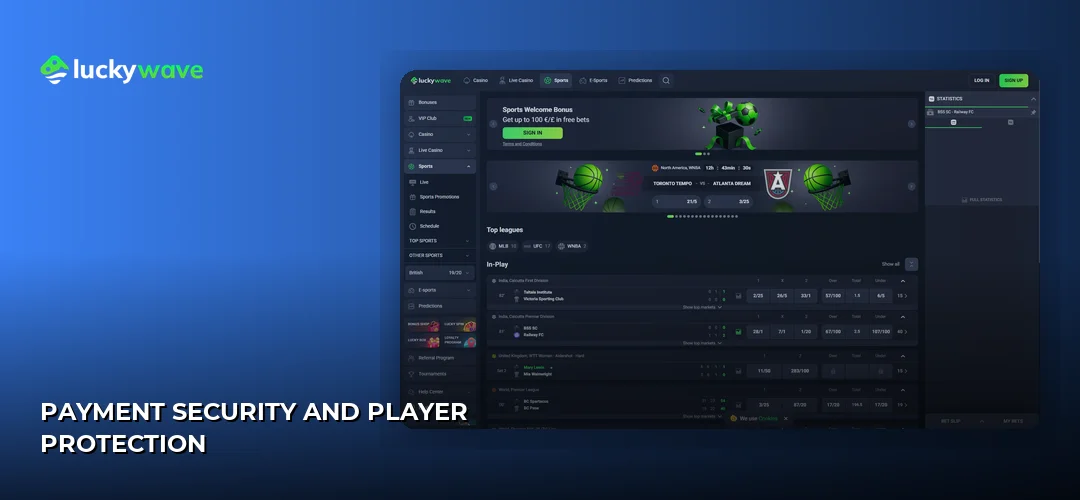
Transactions at LuckyWave are protected with 128-bit SSL encryption and SHA-256 fingerprinting, which is what stops card and wallet details being readable in transit. The same-method payout rule doubles as an anti-fraud control: money can only travel back to a source you have already proven belongs to you.
Card payments run through the payment providers’ own infrastructure rather than being stored raw by the casino, and the mandatory KYC step — photo ID, proof of address, masked payment-method image — is the operator’s main line of defence against account takeover and third-party funding. If someone else gets into your account, they still cannot redirect a withdrawal to their own card.
On the player-protection side, the account includes deposit limits, time-outs and self-exclusion, with the operator linking to GamCare and GambleAware. Deposit limits are the most useful of the three for everyday budgeting: set them when you’re calm, not after a losing session. Registration is restricted to players aged 18 and over.
Frequently asked questions about LuckyWave
How long does a LuckyWave withdrawal take?
According to the operator, requests are typically processed within 24-48 hours, with approval and verification taking up to 24 hours. After that, e-wallets and Faster Payments arrive the same business day, cards in 1-2 business days and bank transfers in 3-5 business days, though providers can take 7-10 business days on transfers.
What is the minimum deposit at LuckyWave casino?
It depends on the method. E-wallets such as Skrill, Neteller and PayPal start at £10, as does Paysafecard. Debit and credit cards require £20, and bank transfer has the highest entry point at £100. Check the floor before planning a bonus-qualifying deposit, since the code needs a qualifying amount.
What payment methods does LuckyWave accept?
Visa and Mastercard cards, the e-wallets Skrill, Neteller and PayPal, Trustly, Zimpler, open banking via Faster Payments, standard bank transfer, and Paysafecard as a deposit-only prepaid voucher. Cryptocurrencies including Bitcoin, Ethereum, USDT and XRP are also listed. GBP is supported alongside other account currencies.
Are there fees for deposits or withdrawals at LuckyWave?
The casino applies no operator fee on deposits or on standard withdrawals. However, third-party payment providers and banks may charge their own fees or currency-conversion costs. Setting GBP as your account currency and funding it with a GBP card or wallet is the simplest way to avoid conversion charges entirely.
How do I withdraw money from LuckyWave casino?
Complete identity verification first, then open the cashier, select Withdraw, choose the verified method you deposited with, enter an amount above the minimum and submit. Payouts return to the same method used to deposit. You can cancel the request until the team confirms it, after which it is final.
What is the maximum withdrawal limit at LuckyWave?
No single fixed ceiling is published. The transaction cap varies by account, and higher limits are available on request subject to individual verification. Larger withdrawals may be split into multiple transactions. Your bank or e-wallet provider’s own receiving limits apply on top of whatever the casino permits.
Do I need to verify my account before withdrawing from LuckyWave?
Yes, verification is required before any withdrawal is processed. You’ll need government-issued photo ID such as a passport, a recent utility bill or statement for address confirmation, and a masked image of your payment method. Submitting these before you request a payout keeps the first cashout inside the stated window.
Can I use PayPal or cryptocurrency at LuckyWave casino?
Both appear in the listed methods. PayPal sits in the e-wallet group with a £10 minimum deposit and same-business-day payouts after approval. Bitcoin, Ethereum, USDT and XRP are available as a secondary option, but UK players are served primarily through the fiat rails — cards, e-wallets and open banking.
You know the limits, the timings and the documents — the last step is setting up your account and choosing a method that matches how fast you want your money back.